
- Article
- 31 March 2026
Anscombe’s Quartet: The Four Datasets That Proved Statistics Can Lie
In 1973, statistician Francis Anscombe constructed four small datasets that were, by every classical measure, mathematically identical. They shared the same mean, the same variance, the same correlation coefficient, and the same regression line. By the standards of the era, they were the same dataset. When plotted, they revealed four entirely different realities. The Quartet did not just illustrate a flaw in summary statistics. It indicted an entire methodological culture and made an irreversible case for the primacy of graphical analysis in data science.
1. Introduction: The Deception Hidden in the Average
The summary statistic is the workhorse of data science. The mean, the variance, the standard deviation, the Pearson correlation coefficient: these numbers have served as proxies for understanding since the 19th century, from Francis Galton's anthropometric studies to the modern KPI dashboards that populate every executive's morning briefing. They are efficient, portable, and interpretable. They compress the complexity of thousands of observations into a single, digestible number.
They are also, if taken in isolation, profoundly unreliable guides to truth.
The problem is not that summary statistics are wrong. The problem is that they are incomplete. They describe certain properties of a distribution (its center, its spread, its linear association) while remaining entirely silent on its shape. And in the shape of data, entire stories are told: the bimodal distribution that signals two hidden populations, the heavy-tailed distribution that makes your average meaningless, the non-linear relationship that your correlation coefficient sees as "moderate" while hiding a perfect parabolic curve.
Francis Anscombe, in a four-page paper published in The American Statistician, made this case with an elegance that no purely theoretical argument ever could. He made it empirically, with data.
2. The Historical Context: A Methodological Culture Under Pressure
2.1 The Statistician's World in 1973
To appreciate the impact of Anscombe's Quartet, it is necessary to understand the intellectual climate in which it emerged. By the early 1970s, statistical computing had just begun its first serious democratization. Mainframe computers, available at universities and research institutions, could run regression analyses that would have taken weeks by hand in a matter of minutes. This was a revolutionary capability, and it came with a corresponding temptation: the temptation to trust the computer's output implicitly.
The prevailing workflow, one that persists in recognizable form in today's automated modeling pipelines, was to load data, run a regression, and report the statistics. The R-squared value, the coefficients, the p-values: these were presented as self-sufficient summaries of reality. Plotting the data was considered a supplementary, often optional, step, useful for presentations but not strictly necessary for analysis.
Francis Anscombe, a British statistician working at Yale University, was disturbed by this culture. He had long argued that statistical analysis was not a mechanical procedure but a craft requiring judgment, skepticism, and visual intuition. In 1973, he sat down to construct a proof, not a theoretical one but an empirical one. He wanted to create a dataset so undeniable in its implications that no statistician could ignore the lesson.
2.2 Anscombe's Target: "Mechanized" Statistics
In the opening lines of his 1973 paper, "Graphs in Statistical Analysis," Anscombe wrote with characteristic directness:
"A computer should make both calculations and graphs. Both sorts of output should be studied; each will contribute to understanding."
Francis J. Anscombe, The American Statistician, 1973
This statement, while seemingly obvious today, was a pointed critique of contemporary practice. Anscombe was responding to what he called "mechanized statistics": the tendency to delegate judgment entirely to the computer and its algorithms. He observed that many analysts treated statistical output as oracular. If the regression said so, it was so. His paper was designed to demonstrate, in the most concrete terms possible, why this approach was dangerous.
His argument was not that numbers lie. It was that numbers, by themselves, are a projection of reality onto a single dimension: a scalar. A scatter plot projects the same reality onto two dimensions and preserves geometrical structure that the scalar destroys. You need both to understand what you have.
3. The Quartet: Four Datasets, One Statistical Shadow
3.1 The Mathematical Coincidence, By Design
Anscombe constructed four datasets, each consisting of eleven (x, y) pairs. By careful, deliberate construction (what would today be called "adversarial data design"), all four datasets share the following summary statistics, accurate to two decimal places:
- Mean of x: 9.00 (identical across all four)
- Mean of y: 7.50 (±0.01)
- Variance of x: 11.00
- Variance of y: 4.12 (±0.003)
- Pearson correlation coefficient (r): 0.816 (±0.003)
- Linear regression line: y = 3.00 + 0.500x (±0.001)
- R-squared (coefficient of determination): 0.67
An analyst receiving a report of these statistics would have every reason to conclude they were looking at a single, well-behaved linear dataset with a moderate positive correlation. The R-squared of 0.67 suggests the linear model explains a meaningful portion of the variance. The correlation of 0.816 is strong. There is nothing in these numbers to raise an alarm.
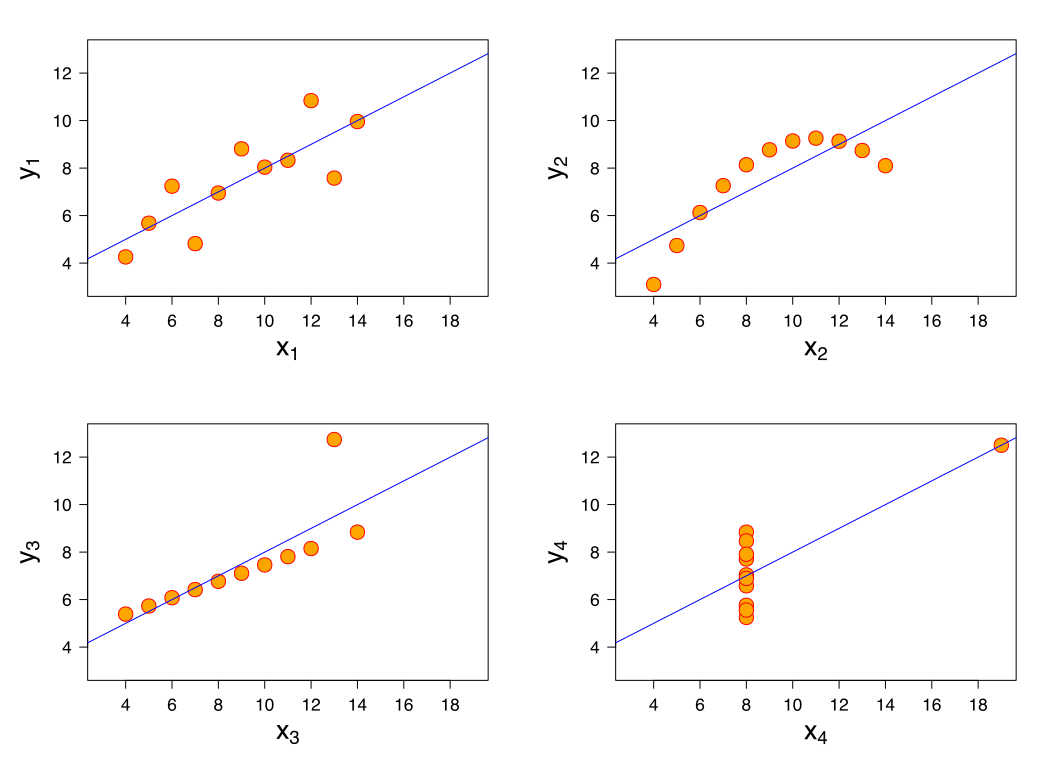
The plots tell four entirely different stories.
3.2 The Four Stories Hidden in the Numbers
Dataset I: The Honest Linear Relationship. The first dataset is what the statistics suggest: a genuine, if noisy, positive linear relationship between x and y. The scatter is moderate and random. A linear regression is the appropriate model. This dataset behaves exactly as a well-designed introductory statistics textbook would hope. It is the null case, the control arm of Anscombe's experiment. It exists to remind us what the statistics look like when they are actually telling the truth.
Dataset II: The Hidden Parabola. The second dataset presents a clear, smooth, non-linear relationship. The data follows a near-perfect parabolic curve. The linear regression model that the statistics describe is not just suboptimal; it is actively misleading. The regression line passes through the cloud of points like a diagonal cut through a bowl, capturing a mean position while misrepresenting the relationship entirely. An analyst fitting a linear model to this data and reporting an R-squared of 0.67 would be communicating a falsehood. The correct model is a second-degree polynomial. The statistics, faithfully computed, would never tell you this.
Dataset III: The Leverage Point. The third dataset is the most instructive for practitioners of machine learning and predictive modeling. The underlying data is, in fact, a perfect linear relationship: ten points lying precisely on a single line. This is a case where the linear model would be essentially correct. But there is one outlier, a single point positioned far above the regression line. This one observation, representing perhaps a data entry error, a sensor malfunction, or a genuinely anomalous event, drags the fitted line away from the true relationship. The correlation drops, the residuals are distorted, and the regression line misrepresents the ten clean points that constitute the bulk of the data. Without visualization, the outlier is invisible. Its existence, and its disproportionate influence on the model, can only be diagnosed by looking.
Dataset IV: The Phantom Correlation. The fourth dataset is perhaps the most philosophically troubling. It consists of nine points clustered vertically at a single x-value (x = 8), plus one additional point positioned far to the right at x = 19. The nine clustered points define no linear relationship whatsoever: they have identical x-values and varying y-values, producing a vertical line segment. The tenth point, the isolated outlier, is entirely responsible for generating the reported correlation of 0.816. Remove that one point and the correlation drops to exactly zero. The linear model, and all the summary statistics that accompany it, is an artifact of a single observation. It does not describe a relationship in the data. It describes a lever.
Anscombe's Quartet: Interactive
Click each dataset. The statistics panel never changes. The plot does.
| Mean(x) | 9.00 |
| Mean(y) | 7.50 |
| Var(x) | 11.00 |
| Var(y) | 4.12 |
| r (Pearson) | 0.816 |
| R² | 0.67 |
4. The Epistemological Argument: What Geometry Reveals That Numbers Cannot
The Quartet's construction articulates a precise point about the information capacity of different representational forms. A set of summary statistics projects a distribution onto a small number of scalar values, each describing one moment of the distribution. Mean and variance capture the first and second moments. The Pearson correlation captures the linear component of the joint structure. This projection is irreversible: multiple distributions can share identical projections while differing radically in their actual shape.
Anscombe's argument was that for the decisions most consequential to scientific analysis, choosing a model family, identifying outliers, diagnosing violations of model assumptions, these projected scalars are systematically insufficient. They tell you about the center and spread of a distribution. They tell you nothing about its multimodality, its skewness, its heavy tails, or the presence of hidden subpopulations. They cannot distinguish Dataset I from Datasets II, III, and IV.
A scatter plot, by contrast, preserves the full geometry of the data in two-dimensional space. The human visual system, trained by evolution to detect patterns in spatial arrangements, can instantly perceive the parabola in Dataset II, the outlier in Dataset III, and the vertical cluster in Dataset IV. What requires formal statistical tests to detect numerically, tests for non-linearity, Cook's distance for leverage points, tests for heteroscedasticity, is pre-attentively obvious to the human eye in a well-constructed graph.
This is why Anscombe's paper was not merely a curiosity. It was a recalibration of the epistemological hierarchy in data analysis. Visualization was not a soft skill, a communication tool, or a supplement for non-technical audiences. It was a rigorous analytical instrument with a fundamentally different and complementary information bandwidth to numerical summaries.
5. The Modern Extension: The Datasaurus Dozen (2017)
Anscombe's Quartet remained a pedagogical staple of statistics education for over four decades. But it was also, in some respects, a limited demonstration. Eleven data points across four carefully constructed datasets, however elegant, could be dismissed as a contrived thought experiment.
In 2017, researchers Justin Matejka and George Fitzmaurice at Autodesk Research published "Same Stats, Different Graphs: Generating Datasets with Varied Appearance and Identical Statistics through Simulated Annealing." They had built an algorithm that could take any dataset and, through iterative perturbation, morph it into an arbitrary target shape while constraining the summary statistics (mean, variance, correlation) to remain identical to within two decimal places throughout the entire transformation.
The result was the Datasaurus Dozen: thirteen datasets, all sharing identical summary statistics, each with a distinct geometric form. One dataset forms a perfect star. Another forms concentric circles. One, the Datasaurus Rex that gave the project its name, forms a dinosaur.
The Datasaurus Dozen extended Anscombe's proof in two critical ways. First, it demonstrated that the phenomenon was not a mathematical curiosity but a general property of the relationship between summary statistics and data geometry. Any target shape, however complex or absurd, could be made to match any set of summary statistics. The gap between what the numbers say and what the data looks like is not a narrow exception. It is a vast, inexhaustible space of possible deceptions.
Second, the use of simulated annealing, a computational optimization technique borrowed from metallurgy, demonstrated that this problem was algorithmically solvable at scale. A machine could systematically generate an infinite number of datasets that would be statistically indistinguishable while being visually, meaningfully, and categorically different. The implication for automated analytics pipelines, systems that report summary statistics without rendering visualizations, was stark.
6. Implications for Modern Data Science
6.1 The KPI Dashboard Trap
Consider the modern business intelligence environment. A company's data team builds a dashboard that reports, for each market segment: average revenue per user, variance of order values, and the correlation between marketing spend and conversion rate. The executive team monitors these metrics weekly. The numbers are stable, the correlations are healthy, and the variance is within acceptable bounds.
What the dashboard cannot tell you is whether the average revenue per user conceals a bimodal distribution, one cluster of high-value enterprise customers and one cluster of near-zero free-tier users, that requires two entirely different product strategies. It cannot tell you whether the correlation between marketing spend and conversion is being driven by a single anomalous campaign in one geography, the Dataset IV phantom leverage point of your business analytics. It cannot tell you that the stable variance in your order values is produced by two opposing trends perfectly canceling each other out, a growing luxury segment and a shrinking mid-market summing to a flat average that signals calm while the underlying distribution bifurcates.
These are not exotic edge cases. They are the natural geometry of real-world business data. And they are, in the language of Anscombe's Quartet, the difference between Dataset I and Datasets II, III, and IV.
6.2 The Machine Learning Model Validation Crisis
The implications extend with particular force into machine learning model validation. The standard toolkit for evaluating a model (accuracy, precision, recall, F1 score, AUC-ROC) is itself a collection of summary statistics. A classification model with an accuracy of 92% sounds excellent. It says nothing about which 8% are being misclassified, whether those errors are clustered in a specific subpopulation, or whether the model's confidence calibration is systematically biased in ways that an accuracy metric cannot capture.
The practice of examining residual plots, the distribution of prediction errors, is the machine learning equivalent of Anscombe's advice to plot your data. It is the step that transforms a model from a black number into an understood system. A residual plot that shows systematic patterns (a funnel shape indicating heteroscedasticity, a curve indicating non-linearity, clusters indicating subpopulation bias) reveals failures that no single scalar metric will surface. The metric reports the average performance. The plot shows where and how the model is wrong.
In high-stakes applications (medical diagnosis, credit scoring, fraud detection), the difference between the metric and the residual plot can be the difference between a deployed system and a liability. An algorithm that performs well on the F1 score but systematically fails on a specific demographic segment will not reveal this failure to an analyst who reads only the summary statistics. It will reveal it to an analyst who plots the errors by demographic group and looks.
6.3 Distribution Blindness and the Normality Assumption
A third domain where Anscombe's lesson applies with particular urgency is the treatment of distributional assumptions. The majority of classical statistical methods, linear regression, t-tests, ANOVA, Pearson correlation, assume that the underlying data is approximately normally distributed. In practice, this assumption is violated more often than it is honored.
Financial return distributions have fat tails that make normally-distributed models catastrophically underestimate the probability of extreme events. Customer lifetime value distributions are typically log-normal, with a small number of high-value customers dominating the aggregate. Time-to-event data in clinical trials follows exponential or Weibull distributions. In none of these cases does a summary statistic reveal the distributional shape. In all of these cases, the choice of an inappropriate distributional assumption, made in ignorance because no one plotted the data, propagates through every downstream analysis, producing intervals that are too narrow, predictions that are too confident, and decisions that are too assured.
Anscombe's Quartet does not show you a fat-tailed distribution. It shows you something more fundamental: that the numbers you compute are not the data. They are a projection of the data. And projections, by mathematical definition, destroy information about the dimensions they collapse.
7. Conclusion: The Visualization Imperative
Anscombe's Quartet is fifty-two years old. The Datasaurus Dozen is eight. Between them, they bookend a period in which computing power has grown by a factor of roughly ten billion, statistical software has been democratized to the point of being embedded in spreadsheet tools, and machine learning has moved from academic curiosity to industrial backbone. None of these developments have made the lesson of the Quartet obsolete. If anything, they have made it more urgent.
The modern data scientist operates in an environment of unprecedented computational abundance. The ability to fit a model, compute a metric, and make a decision has never been easier or faster. The temptation to equate computational ease with analytical thoroughness has never been greater. And the gap between what the statistics say and what the data shows has never been harder to perceive, because the toolchain that computes the statistics is identical to the toolchain that should be generating the plots.
Anscombe's argument was never that numbers are wrong. It was that they are incomplete. The practice of data science, the genuine intellectual discipline as opposed to the mechanical execution of algorithms, requires closing that incompleteness with the one tool that engages the full pattern-recognition capacity of the human analyst: the visualization.
Plot your data. Always. Before the model, before the metric, before the meeting. Plot the residuals. Plot the distribution. Plot the time series. Plot the subgroups. This is not a recommendation for the risk-averse or the methodological purist. It is the minimum viable practice of a discipline that Anscombe, in four pages and four datasets, defined fifty years ago.
The quartet is still playing. The question is whether we are listening.
Ready to unveil your data?
Join hundreds of engineers and researchers who trust NVEIL to turn complex data into actionable insights.
Start for Free